
Worried About Pesticide Residues? Here’s the FDA’s Latest Data
October 1, 2026
Pesticide residues can be a source of confusion in the produce aisle, but the FDA’s latest findings provide helpful context. In its Pesticide Residue Monitoring Program Report for Fiscal Year 2024, the agency analyzed more than 2,900 fresh and processed fruit and vegetable samples —787 domestically produced and 2,126 imported. Nearly 90 percent complied with EPA tolerances, and more than 30 percent had no detectable residues.
To put those numbers in perspective, the Alliance for Food & Farming (AFF) reviewed the results with consumers in mind. The report covers samples collected from October 1, 2023, through September 30, 2024, and tested for approximately 780 pesticides and industrial compounds.
The Numbers at a Glance
- Overall, 89.6 percent of all fruit and vegetable samples had no violative pesticide residues, while 33.4 percent had no detectable residues.
- Domestic samples had a 97% compliance rate (98.4% for fruit, 95.9% for vegetables), and imported samples had an 87% compliance rate (88.7% for fruit, 86.1% for vegetables.
| Category | Samples analyzed | Complied with EPA tolerances | No residues detected |
| All fruit and vegetable samples (domestic & imported) | 2,913 | 89.6% | 33.4% |
| Domestic fruits | 245 | 98.4% | 17.6% |
| Domestic vegetables | 542 | 95.9% | 35.6% |
| Imported fruits | 756 | 88.7% | 27.8% |
| Imported vegetables | 1,370 | 86.1% | 38.5% |
What These Results Mean for You
The big picture is reassuring: the overwhelming majority of fruits and vegetables tested met federal pesticide standards. Rather than giving shoppers a reason to avoid produce, the findings add to the evidence that shoppers can choose conventional or organic options with confidence.
EPA tolerances include wide safety margins designed to protect public health, including infants and children. At the same time, most Americans still do not eat enough fruits and vegetables. The takeaway is simple: choose the produce you enjoy and can afford, whether it is organic or conventional, and eat more of it.
USDA Data Tell a Similar Story
The FDA results are not an outlier. USDA’s Pesticide Data Program (PDP) reached a similar conclusion in its 2024 Annual Summary: more than 99 percent of the 9,872 samples tested fell below EPA residue limits. Of those, 9,165 were fresh and processed fruit and vegetable samples.
The programs look at the food supply from different angles. USDA’s PDP is voluntary and produces nationally representative residue data. FDA’s monitoring program is regulatory and enforces EPA tolerances for foods in interstate commerce
and for imports. Read together, the two reports provide complementary snapshots of pesticide residues in the U.S. food supply.
The Bottom Line About Pesticide Residues
Both the FDA and USDA data point in the same direction: pesticide residues on fruits and vegetables – organic and conventional – are overwhelmingly within federal limits. For shoppers, the healthiest option is to keep fruits and vegetables on the menu. Visit our calculator to see how many servings a man, woman, teen or child could consume and still not have any adverse effects from pesticide residues.
Common Questions About Pesticide Residues
Are fruits and vegetables safe when it comes to pesticide residues?
The FDA and USDA data support that conclusion. In the FDA’s FY 2024 report, nearly 90 percent of all fruit and vegetable samples complied with EPA pesticide tolerances or had no detected residues. Compliance reached 97 percent for domestically grown samples and 87 percent for imported samples. USDA’s 2024 Pesticide Data Program also found that more than 99 percent of all human and animal food samples—most of them fruit and vegetable samples—were at or below EPA limits.
What did the FDA test in fiscal year 2024?
The agency tested 3,528 human food samples and 306 animal food samples for approximately 780 pesticides and selected industrial compounds between October 1, 2023, and September 30, 2024.
Are imported foods held to the same standard as domestic foods?
Yes. The FDA enforces the same EPA tolerances for imported and domestic foods. In FY 2024, 87 percent of imported fruit and vegetable samples complied with EPA standards. AFF supports strong, science-based enforcement for all foods sold in the United States, regardless of origin.
Do I need to buy organic produce to avoid pesticide residues?
No. Both organic and conventional fruits and vegetables are safe, healthy choices, and both must comply with EPA standards. The best option is the one that helps you put more fruits and vegetables on your plate. In other words, choose the produce you enjoy, whether it is organic or conventional, and eat more of it.
Where can I learn more?
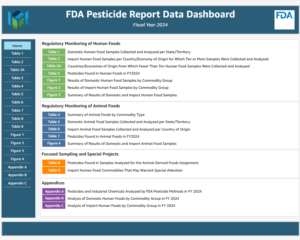
The full report and the FDA Pesticide Report Data Dashboard are available on FDA.gov. The Alliance for Food and Farming – a non-profit organization made up of farmers and organizations representing farmers who grow fruits and vegetables – also publishes consumer resources at www.SafeFruitsAndVeggies.com.
Organic and conventional fruits and vegetables meet strict EPA pesticide residue standards

Leave a Reply
Want to join the discussion?Feel free to contribute!